Tuesday, November 29, 2011

Proper robe à la polonaise: Inspiration and some research

It's been a long while since I posted anything but there's something that I've been working on for a month or so. The beginning of this post was written in late October and now I've already finished the dress I'm talking about here. I'm going to write another post with pictures of the whole outfit as soon as I can.

25th of October, 2011

After a couple of weeks of considering what to make out of the new fabric I bought just a while ago, I decided it's going to be a dress that some of you might call "a proper polonaise". For a long time I've been waiting for a chance to make something similar that was worn by Kirsten Dunst in the movie Marie Antoinette (look for photos of the particular dress at the end of this post) so now I've begun with it. The dress is going to be made out of dark purple taffeta - to mention, I've been looking for affordable dark purple taffeta for ages - with a white petticoat. So far I've drawn the pattern and fitted it for a couple of times and the cutting is next up, if lucky, already tomorrow.

This is the design I'm dealing with...


 First off, some examples of surviving 18th century garments:


Polonaise about 1775-1785

Here's a translation to what the museum has to say about this gown: 

"Polonaise in striped silk in salmon colour and decorations based on knitting applied to green silk taffeta. The neckline, round in the front and with folded neck. The sleeve, long and tight, closes on the wrist with 5 cylindrical buttons covered with silk thread. The seams are covered with braided cord that finishes at the waist and turns into a hanging cord and tassel. Neck, shoulders and cuffs are done in draped green silk.

This dress, known internationally as “robe à la polonaise”, was called “polonesa” in Spain, and it was fashionable during the reign of Charles III. The most characteristic feature of this dress was the skirt puffed in three parts by means of a sliding cord. The Spanish identity of this polonaise is given by the decorative elements as the draping on the shoulders that hide the shoulder seams."

Thanks to my friend who helped me with the translation!


Oringinal can be found at: Polonaise dress 1778, MET


Examples of polonaises in paintings: 
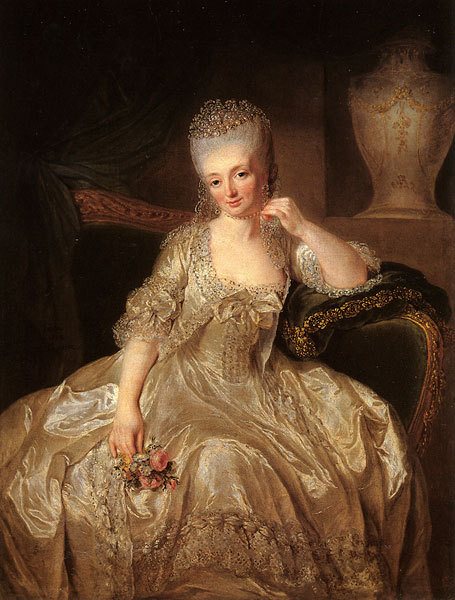
Princess Amalie of Preussen (1771) by Anna Dorothea Therbusch.

Portrait of an elderly lady with her daughter (1775).

Queen Charlotte by Benjamin West, 1776.

Unknown Woman (1779) by Jens Juel.

Jane, Duchess of Gordon and her Son, the Marquis of Huntly (1778) by George Romney. 

Portrait of the Comtesse d’Artois, Maria Teresa of Savoy (ca. 1780) by an unknown artist.
Examples of polonaises in movies:

This polonaise from Sofia Coppola's Marie Antoinette (2009) was my first and main inspiration for this type of dress. You can find more screenshots of this dress on one of my favorite webpages:  Marie Antoinette's Peach gown on Costumer's Guide


Seeing this fashion plate was the turning point when I finally decided it's going to be a dress of this sort!


At the end I left out the bows (see the design) and added a red velvet belt with a beautiful square buckle in the front... Stay tuned for photos in the near future! ;)

Thursday, September 22, 2011

1950's inspired graduation dress photos

It's been a long time since I updated my blog last time. I've been feeling a little uninspired to do anything costume-related during my spare time because school has been quite hectic an it has killed my muse, in a way. I guess most of you there are familiar with that... Anyway, the graduation dress was finished in time and my friend couldn't have been more happier with it. Here, some shots:


I'm in love with those cute shoes she had bought...

Speaking of other things, I've also finished 18th century stays just a while ago and I wish to take some photos of them, too. And now that I haven't been making anything to myself for a while, I've also started working on new 1780's stays for myself! I'm using a two pattern mixture from the book Corsets, Historical patterns and techniques by Jill Salen. I just hope I get around to sew more in the near future than lately.

Friday, May 27, 2011

W.I.P.: 1950's inspired graduation dress

Some months ago one of my friends asked me to make a graduation dress for her and currently I'm working on it. Right from the beginning we knew it would be either 1920's or 1950's inspired but we decided on 1950's because we thought the shape of the 1950's would look better on her body. As always, I had been researching a lot on the net and immediately I realized she would probably love one of the dresses on Kyoto Costume Institute's Digital archive.

We've already bought the fabrics and I've drafted the pattern, fitted the mock-up to her and cut the pieces out. At the moment I'm sewing the dress together. In the picture on the right you can see some examples of the materials I'm using. She wants to use the dress for less formal occasions and we decided it would be a good idea to wear it as summer dress. So instead of sewing all the poofy tulle into the dress as planned at first, I'm going to
make a separate petticoat.

And here's a quick sketch of the design. The skirt isn't going to be as full as the one in the original Kyoto dress.

Some changes may be possible, as usual... For example, we're considering adding some narrow lace to the hem. But now I've got to head back to work!

Wednesday, May 18, 2011

What is she wearing? Underwear?! (Part 2)

Soo, here's the part two with pictures of the dresses I was talking about in the last post...

The Chemise dress seems to be quite often the first dress of a reenactress and I’m not an exeption, even though I didn’t make it for myself. Some four years ago it was good to start with something simple, quick and easy to make. Chemise dress is also a very alternable and fits well to several people, which makes the dress really useful.  I’m too ashamed to show you the first result because I hadn’t been sewing for a long time when I managed to pull my first Chemise dress together. However, it’s still in use - after I’ve alterned the dress at least two-three times. Last time was about a week ago when the dirty hem wouldn’t wash well anymore so I cut it off and added some ruffles to it to make it look a little more fancier for a ball.

Here’s the latest version of the first Chemise dress that I made:


I also sewed a new Chemise dress for another friend of mine:


Thanks for both ladies for allowing me to post up the photos! 

Tuesday, May 17, 2011

What is she wearing? Underwear?! (Part 1)

A short while ago I was working on two Chemise dresses so here's a little post on the type of the dress. I'll post up some pictures of my creations in the part two as soon as I can.

I’ve managed to find only one existing example of a Chemise dress on Manchester Art Gallery website, read about it here.

Here some examples of Chemise dresses worn for paintings:

Self portrait with Wife (1791) by Jens Juel
Henriette Begouen (1790) by Alexander Roslin
Madame du Barry (1781) by Louise-Élisabeth Vigée Lebrun
A painting of two women by Pehr Hilleström
Comtesse de Provence (1782) by Louise-Élisabeth Vigée Lebrun
Danish Princess Louise Augusta (1790s) by Jens Juel
Madame de Moreton (1782) by Louise-Élisabeth Vigée Lebrun
Louise Augusta (1780) by Jens Juel
 Duchesse Polignac (1782) by Louise-Élisabeth Vigée Lebrun
The Duchesse de Polignac (1783) by Louise-Élisabeth Vigée Lebrun
Lady Elizabeth Foster (1785) by Angelica Kauffmann
Portrait of a Lady with a Book (1785)by Antoine Vestier
Lady Lemon (1788) by George Romney

And some fashion plates of Chemise dresses:

Chemise dress in 1787

Promenade dress with a green underskirt 1780
Chemise dress 1789
An English Morning dress 1788
French revoulutionary fashion plate: January 1792

The word Chemise refers to underwear because the shift was called chemise in french. The dress is also often called Chemise à la Reine (”in the style of the Queen”) which refers to Marie Antoinette, the Queen of France. She was wearing a plain muslin Chemise dress for a painting in 1783.

A portrait of Marie Antoinette (1783) by Louise-Élisabeth Vigée Lebrun
Here's a fashion plate of Chemise dress to be worn in Petit Trianon: