Showing posts with label Robe à la polonaise. Show all posts

Thursday, August 22, 2013

Second Robe à la Polonaise - planning stage

I've got so many exciting projects coming up it's getting hard for me to pick which one I want to do first. As a lonely seamstress I've recently been easily tempted by online group costuming projects because that's the closest I can get to sewing together with friends right now. Before I start blogging about 18th Century Court Ensembles Project (hosted by Kendra of Démodé) there's at least one dress of my dreams to make.  Ever since I realized the purple robe à la polonaise isn't going to fit anymore I started visualizing a new robe à la polonaise. At the moment it's my favorite style of all 18th century gowns and now that I'm used to it, I even find the hanging front kind of appealing. My original idea was to make a pale blue robe à la Polonaise with either wide self-fabric or silk organza trimming and black bows. But by now I know there are at least two light blue robe à la Polonaise gowns made in the recent past by other seamstresses and I'm getting very concerned about the uniqueness of this dress. Or should I say, the lack of it. I'm pretty sure many of you have already seen photos of the recreation of the robe à la Polonaise worn by Madame Elisabeth of France in the painting below. In case you haven't, here's a link to the blog about that dress in particular.

Madame Élisabeth seated at her harp by Charles Leclercq, 1783

At the time I first saw photos of that dress on the net I had just decided to order ice blue silk taffeta from Renaissance Fabrics but had not yet done it. It felt like a really big drawback for me because it started to feel like I'm going to copy that recreation, careless of the fact that I already had had that design in my mind for a long time. Not precisely the same design, but close. So this is where I got stuck. After a short while, I also saw another very similar dress made by Les Corsets de Lola on facebook (also found on this website) and lost almost all will to make the whole dress. That made me ponder the possibility of mixing two dresses: a Spanish robe à la Polonaise from Museo del Traje with light blue robe à l'Anglaise from Abiti Antichi. But somehow I didn't feel as excited about it as I had felt about the original idea. With the two following prints featuring two totally cute robe à la Polonaise gowns, I'm still considering making it in light blue. I would also love to make the petticoat daringly short, with shoes and a hint of ankle covered by stockings showing.

Fashion Plate (1780) from Los Angeles Public Library

The straw hat and the walking stick really complete this pretty little outfit...

1870s print of French Baronesses from 1783

Talking about group costuming projects, some time ago Merja started writing about her thoughts on making a robe à la Polonaise on Livejournal so we thought it would be fun to make them at the same time and arrange a group photography session after we're both done with our dresses and it really brought back my inspiration for this project. I hadn't lost it completely but I guess I just needed something to push me forward. Because I love to draw quick sketches to clear my thoughts, here's the design I was thinking about back in March. And still am, with slight alterations.


And another sketch that was actually made right before the one above. I don't like this as much as the other, but I thought it might be nice to share it anyway. 


Currently I don't feel so well because I've probably caught a cold or something but as soon as I get back on my feet I will finish revamping the floral robe à l'Anglaise asap and then head to see what the local fabric stores have to offer and  then I really hope I will come to a conclusion so that this dream project can finally start coming true. And hopefully, I'll end up having a cute dress something like this in the end: 

Portrait d'une Jeune Dame de Qualité, 1777, by Jean Laurent Mosnier.

Friday, December 2, 2011

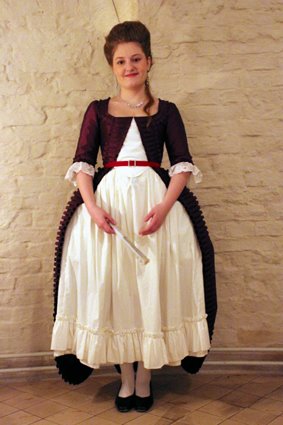
Finished robe à la polonaise at the Christmas ball

Aaand here it is! My new polonaise in action. I made it to be worn in the Christmas ball held in Suomenlinna and the ball was absolutely great - like every year! I met my friends and some great new people. For once I've also documented the dress better than I usually do.. Exept for the shots of me wearing the dress. You rarely have time to take good pictures of the outfit when attending an event and it's also really hard to get good ones because of the candle-lit rooms.


Front view of the dress.

I didn't manage to sew a matching petticoat but luckily one of my old petticoats goes quite nicely with it, don't you think? I do have the fabric for the new one so I'm going to make it when I can.

There is about 4 cm wide pleating on the neck and sleeves and 8 cm wide pleating on the edges of front, widening to 10 cm after waistline. Red velvet band with a square buckle on the waist. The front fits close to skin on the waist unlike many of the polonaises that just seem to hang over the waist. I'm just not that fond of loosely fitting garments, though I don't think it looks bad at all now that I'm used to it. I'm very happy with the fit of the dress. It was a real struggle to fit the sleeves well on my own...


And the back... While dancing! The skirt is lifted up with two strings and the velvet band is tied to a bow at the back. The pleating continues all the way around the hem...

And a couple of other photos, with kind of silly faces, but anyway...


The whole dress laid out on the floor.
 

The same on the inside. And yes, I know you shouldn't sew the lace into the sleeves but I got really frustrated about detachable sleeve ruffles and didn't want to make several shifts just to get different kinds of laces to different dresses.

The back-side.


The front closes with pins on the other side and the white stomacher is sewn into the dress on the other side.


Three seams in the back. First I was considering adding golden cord with tassels on the seams but in the end I thought it looked better without.


For the first time I didn't want any machine-sewing to be seen on the outside so I stiched everything by hand, except the seams on the inside, of course.


Some close-ups of the pleating that was pinked with pinking shears bought from here.


As a conclusion, I'm quite satified with this dress and it has to be my favourite in my 18th century garderobe at the moment. I think I will never do everything by hand because it's just not my thing, plus I don't consider myself as a reenactor, but a costume maker/lover. And I also just don't have the time nor the will to make everything by hand. Making this dress took so much of my time from other things that I'm atually left behind in my studies (ouchy!), plus I felt so bad because I wasn't paying much attention to my partner and my friends because I was just sewing the whole spare time that I had! So for a while I think I'm forced to put aside all my 18th century sewing projects - no matter how much I'd love to sew them now, specially because I'm feeling inspired after meeting so many other awesome costumers.


Some decorations that I used for my hair and the velvet band with a lovely square buckle..

The photos of me wearing the dress were captured by two lovely ladies, madame Petranella and Katariina Augustintytär (Read her blog here: Before the Automobile). Thanks to both of them!

Ps. I appologize for any typos that I might have made... I try to write correctly and read though the whole text carefully a couple of times before submitting it but usually I still find a few typos later on. Please, do note me about them if you notice any, so that I can correct them.

Tuesday, November 29, 2011

Proper robe à la polonaise: Inspiration and some research

It's been a long while since I posted anything but there's something that I've been working on for a month or so. The beginning of this post was written in late October and now I've already finished the dress I'm talking about here. I'm going to write another post with pictures of the whole outfit as soon as I can.

25th of October, 2011

After a couple of weeks of considering what to make out of the new fabric I bought just a while ago, I decided it's going to be a dress that some of you might call "a proper polonaise". For a long time I've been waiting for a chance to make something similar that was worn by Kirsten Dunst in the movie Marie Antoinette (look for photos of the particular dress at the end of this post) so now I've begun with it. The dress is going to be made out of dark purple taffeta - to mention, I've been looking for affordable dark purple taffeta for ages - with a white petticoat. So far I've drawn the pattern and fitted it for a couple of times and the cutting is next up, if lucky, already tomorrow.

This is the design I'm dealing with...


 First off, some examples of surviving 18th century garments:


Polonaise about 1775-1785

Here's a translation to what the museum has to say about this gown: 

"Polonaise in striped silk in salmon colour and decorations based on knitting applied to green silk taffeta. The neckline, round in the front and with folded neck. The sleeve, long and tight, closes on the wrist with 5 cylindrical buttons covered with silk thread. The seams are covered with braided cord that finishes at the waist and turns into a hanging cord and tassel. Neck, shoulders and cuffs are done in draped green silk.

This dress, known internationally as “robe à la polonaise”, was called “polonesa” in Spain, and it was fashionable during the reign of Charles III. The most characteristic feature of this dress was the skirt puffed in three parts by means of a sliding cord. The Spanish identity of this polonaise is given by the decorative elements as the draping on the shoulders that hide the shoulder seams."

Thanks to my friend who helped me with the translation!


Oringinal can be found at: Polonaise dress 1778, MET


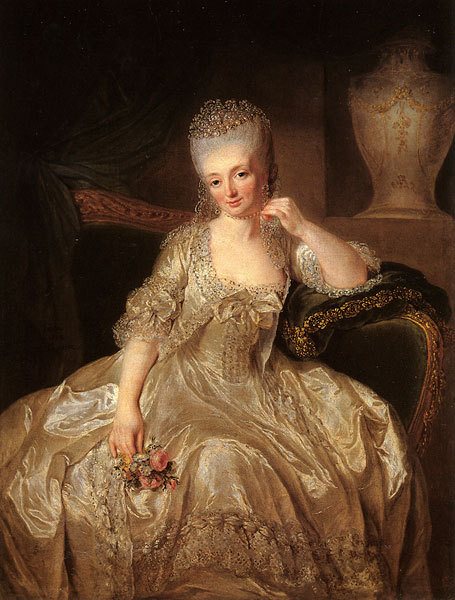
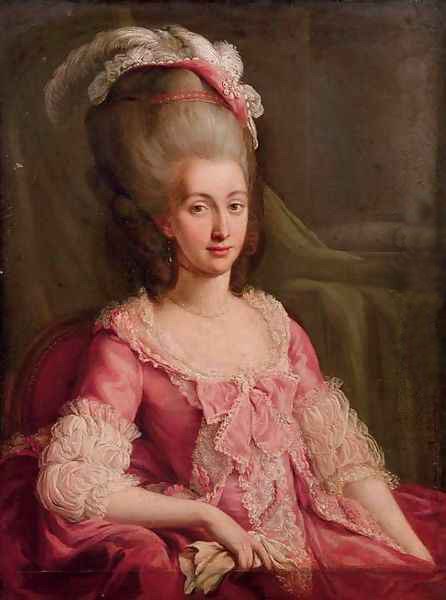
Examples of polonaises in paintings: 

Princess Amalie of Preussen (1771) by Anna Dorothea Therbusch.

Portrait of an elderly lady with her daughter (1775).

Queen Charlotte by Benjamin West, 1776.

Unknown Woman (1779) by Jens Juel.

Jane, Duchess of Gordon and her Son, the Marquis of Huntly (1778) by George Romney. 

Portrait of the Comtesse d’Artois, Maria Teresa of Savoy (ca. 1780) by an unknown artist.
Examples of polonaises in movies:

This polonaise from Sofia Coppola's Marie Antoinette (2009) was my first and main inspiration for this type of dress. You can find more screenshots of this dress on one of my favorite webpages:  Marie Antoinette's Peach gown on Costumer's Guide


Seeing this fashion plate was the turning point when I finally decided it's going to be a dress of this sort!


At the end I left out the bows (see the design) and added a red velvet belt with a beautiful square buckle in the front... Stay tuned for photos in the near future! ;)