Showing posts with label Museums. Show all posts

Monday, July 29, 2019

An 18th century day at Suomenlinna, 2017

When it comes to historical events and travelling, the past three years have been busier for me than any of my previous years in the hobby before. It has been absolutely wonderful but it also meant that when I've been at home, I have been frantically preparing for a trip on my time off, which lead to the complete neglect of this blog. With the limited free time and energy available, I've chosen sewing over updating the blog. Also, in the past three years I've found, like so many of you, that Instagram has been a more convenient place for me to share my work and photos of events. However, I never wanted to give up on this blog either because I feel like having a more permanent place for my photos and I still want to write posts about my costumes every once in a while.

This post is about an event back in July 2017. I didn't plan to go to it because I found out about it just a couple of weeks before it took place. However, it was too fun an event to pass up, so I made a bit of an impromptu trip to Helsinki for a weekend.


The neat thing about this day was that we got to travel to Suomenlinna islands in proper 18th century style on an 18th century reproduction cannon sloop Diana


It may have been July but the weather made it seem more like September.


The whole passenger group captured upon arrival to Suomenlinna. 


Once we got to Suomenlinna, we set up a picnic and played some pall-mall, as per usual. 


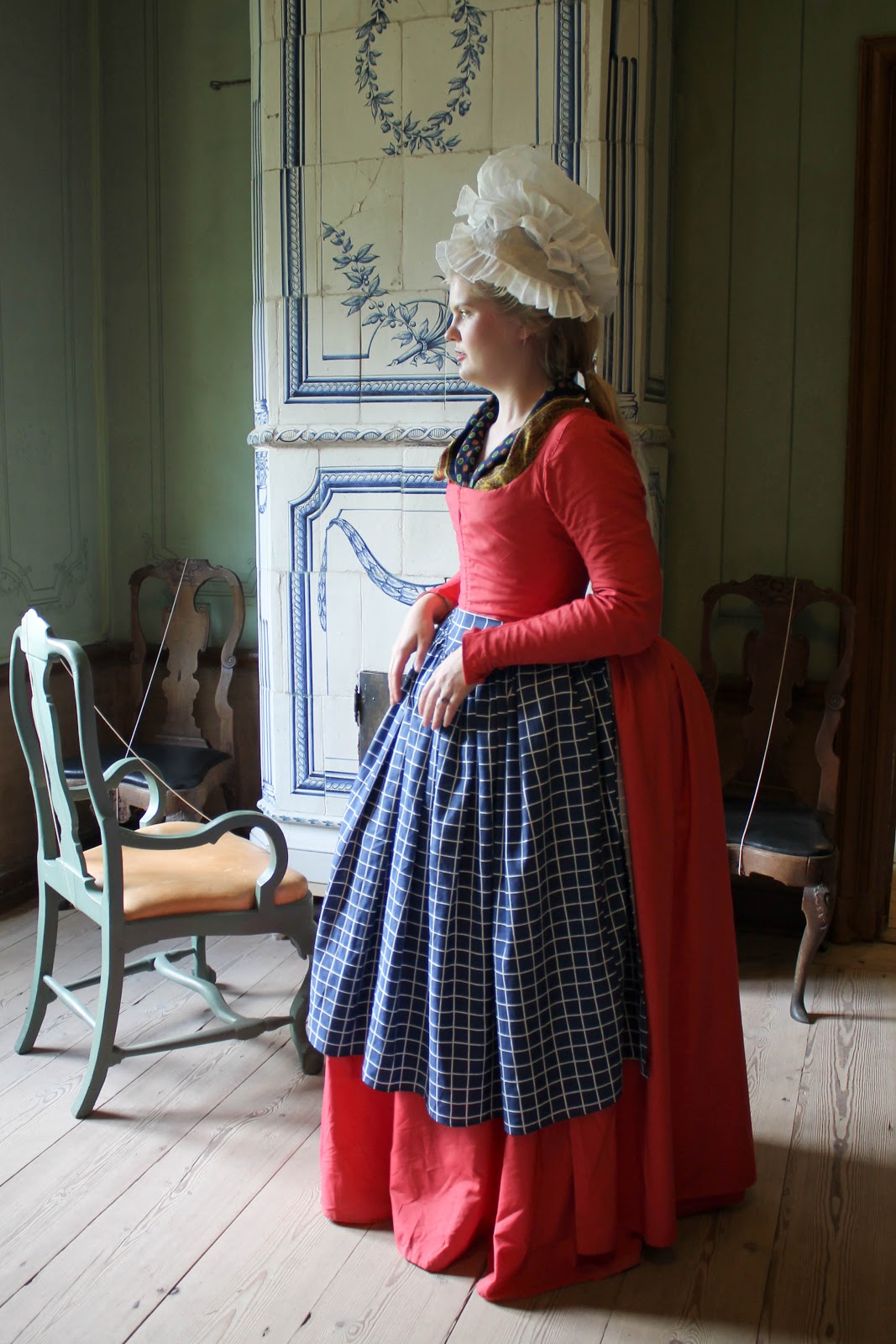
We also visited the commandant's house aka the Ehrensvärd museum, named after the founder of Suomenlinna sea fortress, Augustin Ehrensvärd, whose official residence the house was. The house was built in the 1750s and the interiors of the museum are furnished in 18th century style.


I had quickly sewn two new garments for the trip the week before; a red petticoat and a 1780s apron with ruffles.


However, Ehrensvärd actually didn't live in the house as he lived in a cottage (that no longer exists on the islands).

Augustin Ehrensvärd (1710-1772), c. 1770, presumably after J. H. Scheffel.


Ehrensvärd was the first to have a tiled oven in Helsinki. Sadly the first oven from mid 1750s was destroyed in a bombing during the Crimean war in 1855 so the ones that are in the museum today are not original to the building.


Augustin Ehrensvärd was not only a military officer and architect but also an artist. There are several of Ehrensvärd's ink drawings on display at the museum.


We also got to see a minuet dance performance and enjoy some harp music while we were in the museum.  


This was the first time Mia invited her sister to join us to an event. Aren't they adorable? :)


Portrait of Gustaf Mauritz Armfelt (1757-1814).


Afterwards we had lunch at the Café Piper. The weather had suddenly turned all summery so we played cards in the garden before heading home.

Friday, July 25, 2014

A visit to a local museum

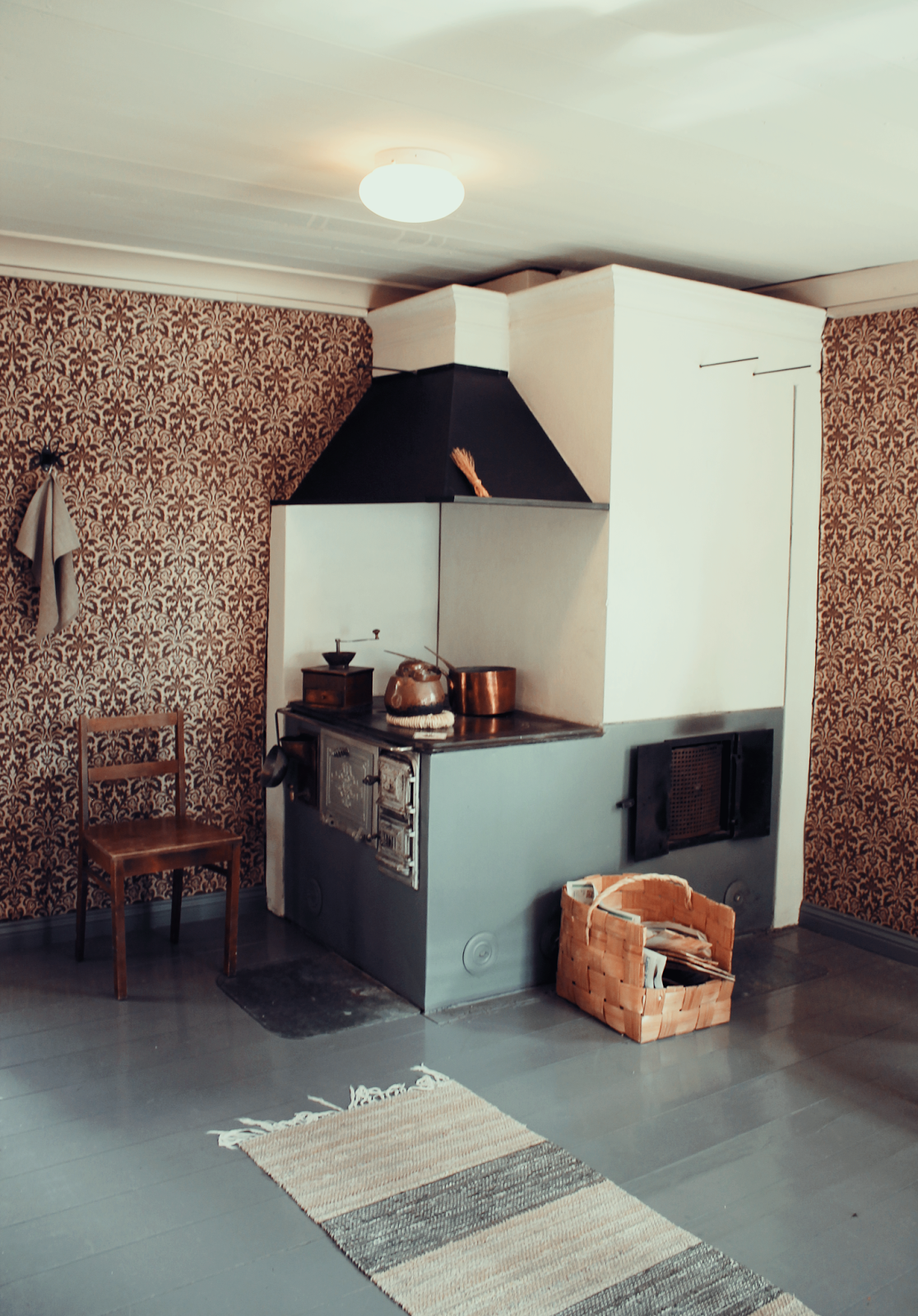
A week ago I finally went to see a small local museum that I've been meaning to visit for ages but never got around to go there. It's called Sailor's Home Museum and it's located in a building that was built in the 1730s. The rooms of the house are furnished in 1880s style to represent a sailor's home and tenant's quarters. Because I actually ought to be sewing for an event that's only two weeks from now, I'm simply going to share my photos from the museum without much further introduction.

We'll start with the tenant's quarters...


The wallpapers of the house were probably my favorite part from the museum. They were beautiful and I also loved that they weren't all perfect and spotless but they were partly crumpled on the walls and had imperfections in the matching of the papers.


Two of the rooms in the house also had painted walls instead of wallpapers.


The blue bed chamber was my favorite, of course! ;)


A close-up of the lovely wallpaper...


And here's the building from the outside...


The visit to the museum was nice although it was a very short one since I was there with someone who is almost not at all interest in history and who doesn't have much understanding nor appreciation for photography either. This is unfortunately not the first time I get reminded that you really should always go to a museum who is as much interested in seeing it as you... and who has the patience to wait for you to take as many photos as you like so you don't have to take them hastily...

The next post will be about sewing, I swear! ;)

Wednesday, January 11, 2012

CER.ES: Online Collection and how to search

It's been a real pity that the Imatex online collection hasn't been available for ages because they had some very pretty extant 18th century costumes in the collections. Now some of the objects are available on Colecciones en Red online collection. The page is in Spanish so if you don't understand the language it can be a little difficult to find things. However, after trying various options I've found a way to get around.

Try search words such as polonesa (polonaise), vestido (dress), Museo del Traje and robe and click 'buscar' to search. After getting on the list of the search results, click on the 'Ficha completa' for more information and to see a bigger image. Click 'Ampliar Imagen' under the image to enlarge. There's also advanced search 'Busqueda avadaza' available and it's not too hard to understand the search options, specially if you use Google translator. I know Google translator is usually a bummer but in simple cases such as this it helps you to get an idea about the texts on the page.

You can find some of the objects that are in the collection more easily on Museo del Traje's Visita Virtual page.

This is definitely not one of the best online collections I've seen but it's nice anyway. The large views of the images aren't that large, really, there aren't many views on the objects and you usually can't open the links on tab, which I find tedious because you have to click the 'more information' link and get back on the search result list page in order to click the next object for more information.

Happy searching! ;)

Tuesday, November 29, 2011

Proper robe à la polonaise: Inspiration and some research

It's been a long while since I posted anything but there's something that I've been working on for a month or so. The beginning of this post was written in late October and now I've already finished the dress I'm talking about here. I'm going to write another post with pictures of the whole outfit as soon as I can.

25th of October, 2011

After a couple of weeks of considering what to make out of the new fabric I bought just a while ago, I decided it's going to be a dress that some of you might call "a proper polonaise". For a long time I've been waiting for a chance to make something similar that was worn by Kirsten Dunst in the movie Marie Antoinette (look for photos of the particular dress at the end of this post) so now I've begun with it. The dress is going to be made out of dark purple taffeta - to mention, I've been looking for affordable dark purple taffeta for ages - with a white petticoat. So far I've drawn the pattern and fitted it for a couple of times and the cutting is next up, if lucky, already tomorrow.

This is the design I'm dealing with...


 First off, some examples of surviving 18th century garments:


Polonaise about 1775-1785

Here's a translation to what the museum has to say about this gown: 

"Polonaise in striped silk in salmon colour and decorations based on knitting applied to green silk taffeta. The neckline, round in the front and with folded neck. The sleeve, long and tight, closes on the wrist with 5 cylindrical buttons covered with silk thread. The seams are covered with braided cord that finishes at the waist and turns into a hanging cord and tassel. Neck, shoulders and cuffs are done in draped green silk.

This dress, known internationally as “robe à la polonaise”, was called “polonesa” in Spain, and it was fashionable during the reign of Charles III. The most characteristic feature of this dress was the skirt puffed in three parts by means of a sliding cord. The Spanish identity of this polonaise is given by the decorative elements as the draping on the shoulders that hide the shoulder seams."

Thanks to my friend who helped me with the translation!


Oringinal can be found at: Polonaise dress 1778, MET


Examples of polonaises in paintings: 

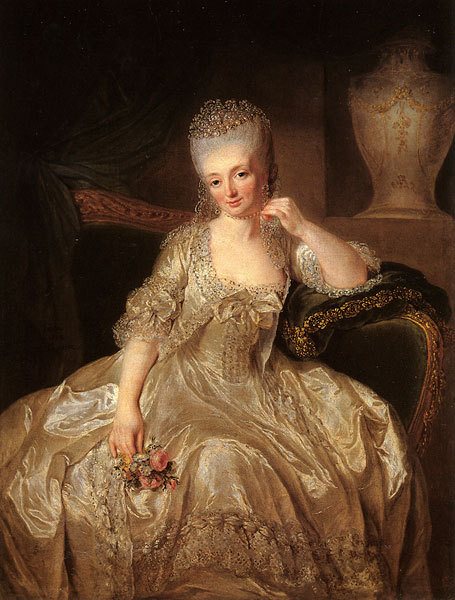
Princess Amalie of Preussen (1771) by Anna Dorothea Therbusch.

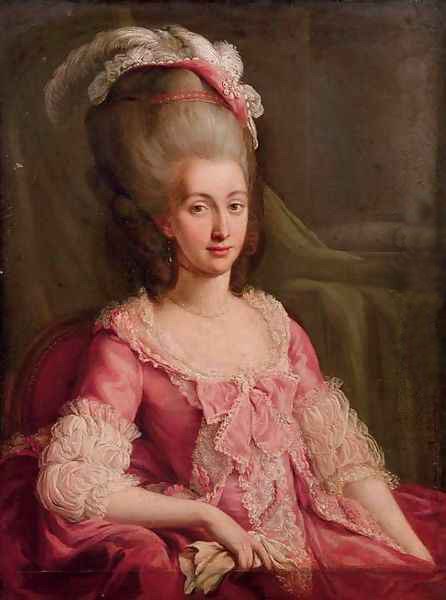
Portrait of an elderly lady with her daughter (1775).

Queen Charlotte by Benjamin West, 1776.

Unknown Woman (1779) by Jens Juel.

Jane, Duchess of Gordon and her Son, the Marquis of Huntly (1778) by George Romney. 

Portrait of the Comtesse d’Artois, Maria Teresa of Savoy (ca. 1780) by an unknown artist.
Examples of polonaises in movies:

This polonaise from Sofia Coppola's Marie Antoinette (2009) was my first and main inspiration for this type of dress. You can find more screenshots of this dress on one of my favorite webpages:  Marie Antoinette's Peach gown on Costumer's Guide


Seeing this fashion plate was the turning point when I finally decided it's going to be a dress of this sort!


At the end I left out the bows (see the design) and added a red velvet belt with a beautiful square buckle in the front... Stay tuned for photos in the near future! ;)