Friday, July 25, 2014

A visit to a local museum

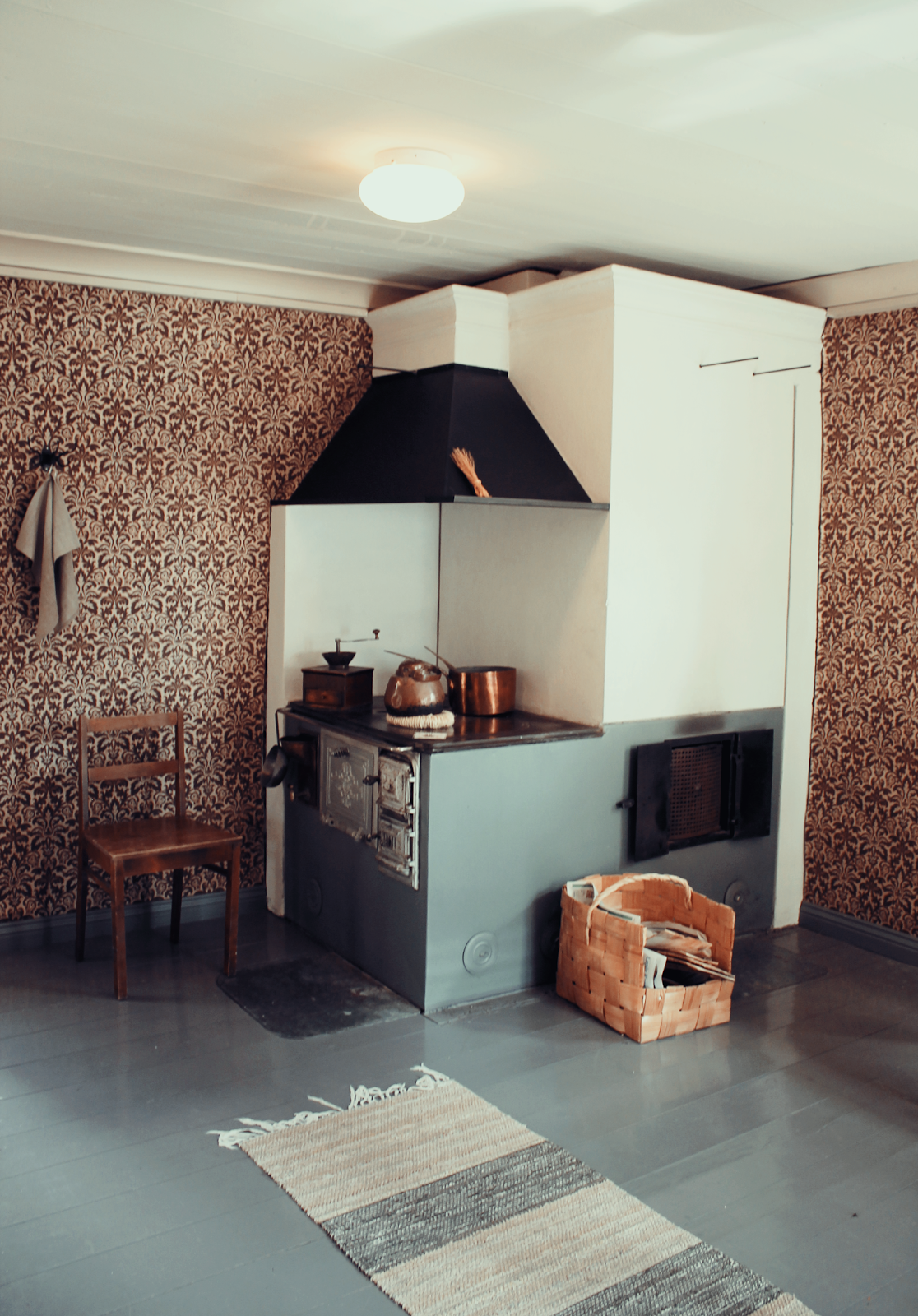
A week ago I finally went to see a small local museum that I've been meaning to visit for ages but never got around to go there. It's called Sailor's Home Museum and it's located in a building that was built in the 1730s. The rooms of the house are furnished in 1880s style to represent a sailor's home and tenant's quarters. Because I actually ought to be sewing for an event that's only two weeks from now, I'm simply going to share my photos from the museum without much further introduction.

We'll start with the tenant's quarters...


The wallpapers of the house were probably my favorite part from the museum. They were beautiful and I also loved that they weren't all perfect and spotless but they were partly crumpled on the walls and had imperfections in the matching of the papers.


Two of the rooms in the house also had painted walls instead of wallpapers.


The blue bed chamber was my favorite, of course! ;)


A close-up of the lovely wallpaper...


And here's the building from the outside...


The visit to the museum was nice although it was a very short one since I was there with someone who is almost not at all interest in history and who doesn't have much understanding nor appreciation for photography either. This is unfortunately not the first time I get reminded that you really should always go to a museum who is as much interested in seeing it as you... and who has the patience to wait for you to take as many photos as you like so you don't have to take them hastily...

The next post will be about sewing, I swear! ;)

Wednesday, July 2, 2014

Similarities...

This following fashion plate has appeared on my Pinterest feed quite a few times over the past couple of days and I guess many of you, who have already seen the said fashion plate and spent a lot of time browsing the pages of The Cut of Women's Clothes by Norah Waugh, have noticed that the cut of the dress depicted in it looks quite close to one of the patterns in the book (see diagram XXXII). It's a pity London Museum doesn't have photos of the original garment, that the pattern was taken from, on their online collections so we can't compare the fashion plate with it.

Journal des Luxus, December 1795.
This fashion plate also reminds of a quite similar dress (in cut) in a painting by Louis Léopold Boilly (below).

At the entrance (1796-1798), by Louis Léopold Boilly.

Why am I bringing this up on the blog, then? Mainly, just out of the joy of sharing and, secondly, because I find the raising waistlines of the 1790's very appealing and would love to sew a gown similar in style to these dresses in the future. This is something I'm only dreaming about so therefore it's not going to happen any day soon. But I wanted to write a brief post abut it anyway since the dresses of this type were definitely on my mind when I began to sew my pair of transitional stays that I think would work wonderfully for something like these gowns, with rising waists and gathered fronts.

Now, who's tempted to buy that fashion plate from Ebay? ;)

Monday, May 12, 2014

Transitional stays c. 1794-1800, chemise and under-petticoat

Here come the photos of the first garments that I've actually finished this year. It's such a relief to get something done completely because my projects haven't exactly gone smoothly in the past four months, which has resulted in leaving me with more UFOs than, well, ever before. That's also why I didn't post anything for a while, but I guess that happens to most of us sometimes, right? :)

Let's start with having a look at the front of the stays. I'm actually really happy I put more bones into the front panels of the stays than in the original pattern because I'm almost certain that there would be more creasing if I hadn't done so. Plus, the extra bones support the bust from below without making the stays any less comfortable. Should I ever make another pair of stays with this pattern, I might place the cups slightly closer to the center front because it's just not possible for my breasts to be quite this far apart - even if the aim is to get that separation effect. The issue doesn't really show much on the photos and I'm quite sure you can't tell once I'm wearing a gown on top of the stays so right now I'm just going to stick with this pair. Also, adding more width to the lower part of the cups might help with the creasing that you can see at the front.


Now we can also compare the results with a period engraving which is actually around ten years later than my transitional stays - but the shape that the stays provide looks basically the same, doesn't it?

The Ladies' Dress Maker, from "Book of English Trades", 1811.

The shape of the cups is controlled on top with drawstrings that run under the twill tape binding. 


Maybe you already noticed that there are actually modern underwires under the cups to support the breasts. Since it looks like there are bones under the cups of the trasitional stays on the MET, I thought I might get away with using them. :)


Unfortunately the photos of the back of the stays were unsuccessful so I'll have to try to get photos of it some other time and add them to the blog later. :/ 

I also made a under-petticoat. At first I wanted to make a bodiced petticoat but then, I really liked the petticoat Merja made for her riding habit, and eventually decided to leave the bodice out so that I wouldn't have to worry about the length of it. I actually didn't sew the shoulder straps into the waist tape of the petticoat at front either - they are only pinned so I can adjust the back depending on how high or low it should be. 

The front of the petticoat is almost triangular so that the petticoat gets wider towards the hem and there's no gathering at waist, which helps to create a smooth figure without making you look like you're larger than you actually are. 


The back is gathered to the waist tape only in the middle, but not on sides. 


And finally, here's the side view.


The petticoat is a bit too long so I will probably have to make it shorter by making a tuck at the hem but after that I'm ready to move on! :)

Monday, May 5, 2014

Fabrics (and cars)

The transitional stays are finished now, along with a new regency chemise, and I'm now eagerly waiting for a chance to photograph them. In the meanwhile, I thought I'd share photos of some exciting fabric purchases.

Thanks to Hertzwerk-Freiburg, I was able to get enough of this pretty floral print cotton with a brown background (something I've tried to find for a while now) to make a dark floral robe à l'Anglaise out of. I'm hoping to get the dress done by August.


The next cotton fabric will turn into an early 1810s gown - very soon, I believe. This is the fabric that has been kicking me to get those regency undies done.


And the following fabric is actually polyester taffeta but at -70% discount I couldn't pass, so I bought six meters for 21 euros and have no regrets. It's a very nice quality and will eventually become a late 1780s/early 1790s robe à l'Anglaise... with a vandyke collar.. maybe... I haven't really decided yet because, in all probability, it's not happening this year.


In case you're not interested in seeing some old cars, you may stop reading this post now... ;)

Wednesday, April 23, 2014

When 18th century sewing gets too overwhelming...

The short story: There are times when I get frustrated with most of my 18th century sewing because - lets face it - sometimes it can be a bit tiresome... and complicated. So what do you do? Bring out the regency to the rescue!

The long story: I've thought about starting making costumes for other periods than just the usual 1770s/1780s for a long time but never quite got around to do it. It was just recently when I realized I really am the social kind of costume maker and by that I mean that it's very hard for me to finish, or get even started on anything at all that I can't wear to events or with friends. So it's not a coincidence that I'm going to start making very late 18th century/early 19th century costumes now that I've become friends with Noora. It's so nice to have someone to talk about your costumes in real life and even more fun to know that you'll have someone to take your new clothes out with, sooner or later. Conveniently, also Merja started making herself costumes from this period a while ago.

Finally, here's proof of what I've been making...


Transitional stays - yay! And I'm near to finishing, only having the tabs of the other half to bind... Of course I ran out of twill tape just when I was about to finish. *sigh* So now I have to head to town to get some more before I can take more photos of the stays on body.


These stays are made out of just two layers of fabric - cotton for the outside and linen for the lining. 


The pattern is from the book Corsets by Jill Salen, with only a couple of alterations. I replaced the bust gussets with breast cups and narrowed the shoulder straps. Also, I increased the amount of bones from five on each side to eight, based vaguely on the transitional stays from V&A. Another pair of stays that I used for inspiration, mainly for the cups, is from Kent State University Museum. However, the shape of the cups (especially on the top) was heavily influenced by the pair from Met.


You can see the final pattern I made for the breast cups in the photo below. I had to make three mock-ups for it until I got it right. The first two were far too small and honestly, the third one could be just a bit larger but it works anyhow. 


It took me a while to figure out how to construct these stays, as the original in the book is also made out of only two layers of fabric so that you don't bind the stays before adding the lining as it's common. Eventually, I constructed the stays by joining the panels by whip stitching  them together after I had turned the seam allowances in between the outer layer and the lining of each panel. Photos will do much better job explaining than I will.


I admit being lazy and stitching the tape on top of seams and the boning channels by machine. :)


Somehow I managed to mess up while measuring the original pattern because I though it would fit but it turned out to be way too small and I had to slice it in two at the back and add eyelets for lacing. I'm quite sure your stays are not supposed to have lacing at the front as well as at the back but this was just so much quicker a solution than starting the whole thing over from the beginning. 


And since I'm quite sure you're all eager to see how these stays look when worn, I give you these two photos snapped quickly with my phone the last time I tried the stays on. Please ignore that I didn't lace them up properly. Also, I'm wearing my 18th century shift under the stays so you can see I definitely need another with a wider neckline and short sleeves. 


I was aiming to be able to wear these stays for costumes from about 1794 stretching into the 1810s, even though the stays itself date to about 1794-1800. I believe I did a pretty good job getting the suitable shape for that period. Or what do you think?


I'll share the rest of my thoughts in the next post once these stays are completely finished.

Saturday, March 29, 2014

Some paintings just need more love...

You know that moment when you stumble upon a gorgeous painting that you haven't seen before? It happened to me today and I immediately felt like sharing this lovely piece of art with everyone.

Portrait of a Lady with her Son (ca. 1792), attributed to Adolf Ulrik Wertmüller.

And doesn't that dress remind you of the one Marie Antoinette wore for this painting?

Marie Antoinette with two of her children (1785) by Adolf Ulrik Wertmüller.

Which one do you prefer? Because at least I'm having hard time to choose!

Thursday, January 2, 2014

Naval riding habit inspiration

The time has come for me to make a riding habit, another one of those projects that I've hoped to make for so long, maybe even longer than any other project. As a child, much before I got into costume making, I used to be interested in pirates as well as naval history. So I've been hoping to make a naval inspired riding habit ever since I realized it would be a much better option than making a naval officer's uniform for myself. The design started to evolve when I stumbled upon a naval inspired riding habit on deviantArt but the original photo got deleted from the site a long time ago so I can't link it here. But I had to mention it anyway because I don't want to take credit from something that wasn't originally entirely my idea.

Anyhow, my major source for inspiration comes from the naval uniforms of National Maritime Museum, which I visited a few years ago. My favourite type of uniform is the full dress uniform of a captain, from 1774. If you've read my post about the floral robe à l'Anglaise, you surely understand why. The reason why I didn't start making a riding habit earlier than this is that I hadn't found suitable wool for it. But a few months ago I did, when I was out visiting the local fabric stores with Noora. I also hadn't found good linen for the habit shirt, but Couture Mayah kindly sent me some linen for it some time ago. The only material I'm still missing is the trim but I'm ready to start making the outfit now because I can order it later.

A Portrait of a Lady (1747) by Roberet Harvie.

At first, I wanted to make the outfit in the 1770s style so I had already bought a pattern for it from Reconstructing History, but after seeing this painting, I changed my mind. Especially because I still have some fabric left from the recent robe à la Francaise that I plan to use for the waistcoat. The details that I love about this painting in particular: The lace collar with a black bow.


And the mariner's cuffs, plus the golden trim.


 For comparison, here are some painting of men in naval uniforms.

Captain Horatio Nelson (1781) by John Francis Rigaud.
John Jervis, Earl of St Vincent (1769) by Francis Cotes.
Captain James Cook (1775-76) by  Nathaniel Dance.

Mrs. Epes Sargent (Catherine Osborne) also wore a blue riding habit for her portrait. But I don't like the wide ribbon tied around her neck with two bows in the front and back because it's quite large. And isn't that pale pink bow in her hair just a bit silly? Maybe she tried to add a feminine touch to the stiff, tailored outfit with it but I don't like it. I also prefer the coat open in the front so that you can see the vest. 

Mrs. Epes Sargent (Catherine Osborne) by John Singleton Copley (c. 1764).

Nancy Fortescue looks fabulous in her blue riding habit, though. I love the tassels!

Portrait of Nancy Fortescue (1745) by Thomas Hudson.

This picture is very small but you can see the lady in the blue riding outfit has got a coat with ermine cuffs and collar. 

Trevelyan family of Wallington, Nothtumberland, English school (1745-50).

For more blue riding habits and uniforms, take a look at this Pinterest board.